

Summary
Currently, only Tropical Storm Norbert remains active in the East Pacific, but another system is forecast to develop soon. A surge of moisture from the Gulf of California has brought higher dewpoints to southern Arizona. Thunderstorms will develop in southeastern Arizona and the Mogollon Rim by the late afternoon and create outflows moving from Tucson to Phoenix and downslope from the Rim. Storms will continue to develop along this outflow boundary as it moves slowly northwest. The associated showers and thunderstorms could bring strong winds, heavy rain, and localized dust.
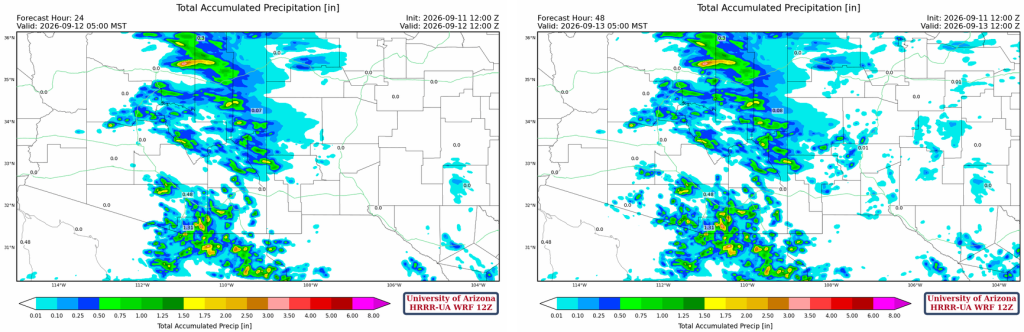
Most precipitation is forecast to fall today, with drier conditions expected across southern Arizona on Saturday except for isolated mountain storms. By Sunday, thunderstorm activity could increase in eastern Arizona and northern New Mexico, but we’ll need to reassess as forecasts evolve. Next week, monsoon moisture will linger nearby, but widespread storms are unlikely unless a trough moves through the region.
Yesterday’s Weather
The visible satellite animation shows that yesterday afternoon, isolated showers and thunderstorms occurred across southern New Mexico, the White Mountains, and south of Sasabe.
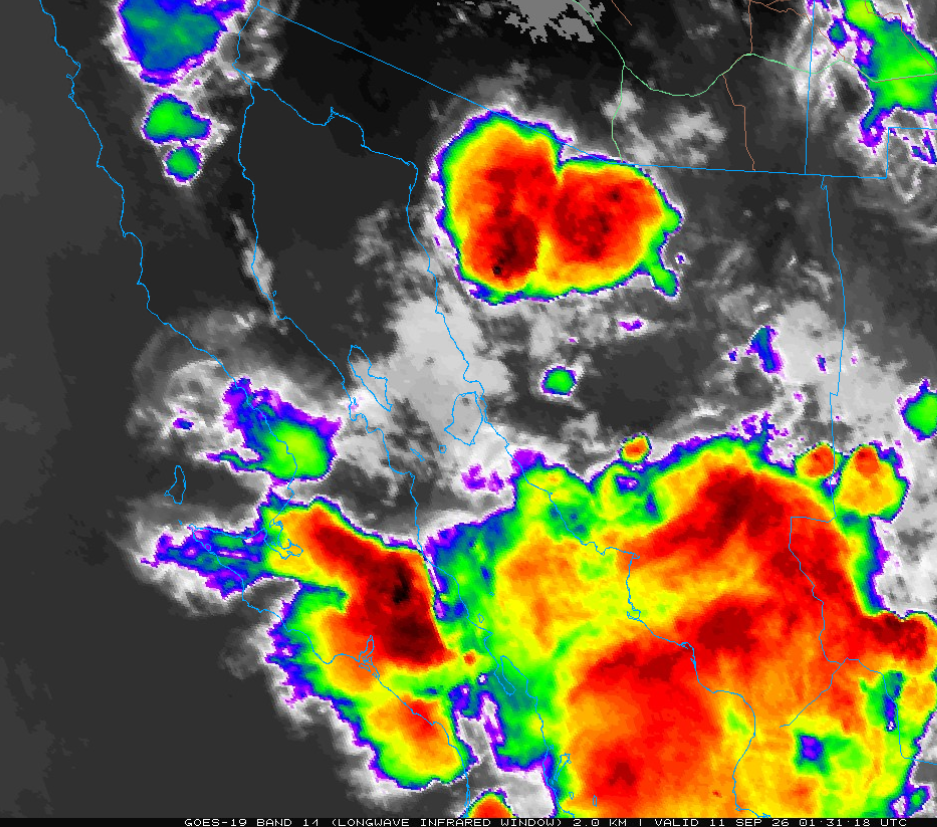
The thunderstorms south of Sasabe became very intense into the evening, as seen on the infrared satellite image, and were north of a Mesoscale Convective System (MCS) farther south in Mexico. The thunderstorms reflect the higher precipitable water available in these areas.
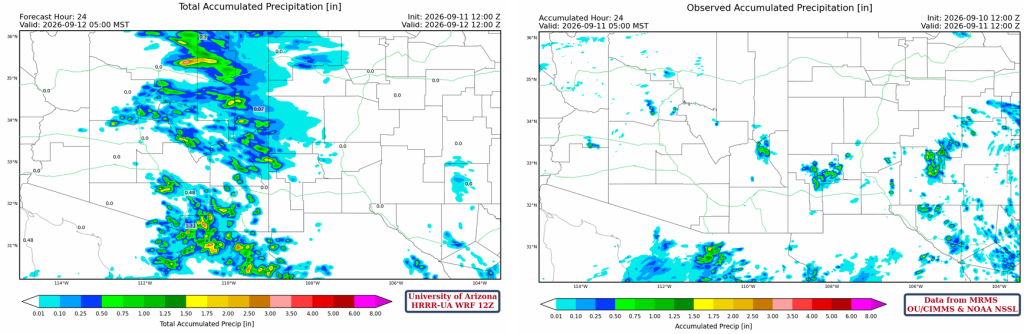
The HRRR-UA WRF 12Z 24-hour accumulated precipitation forecast (left) and corresponding observed precipitation from MRMS (right) are shown below. The forecast was good in both Arizona and New Mexico, but underestimated precipitation south of the border where observations are sparse.
Analysis
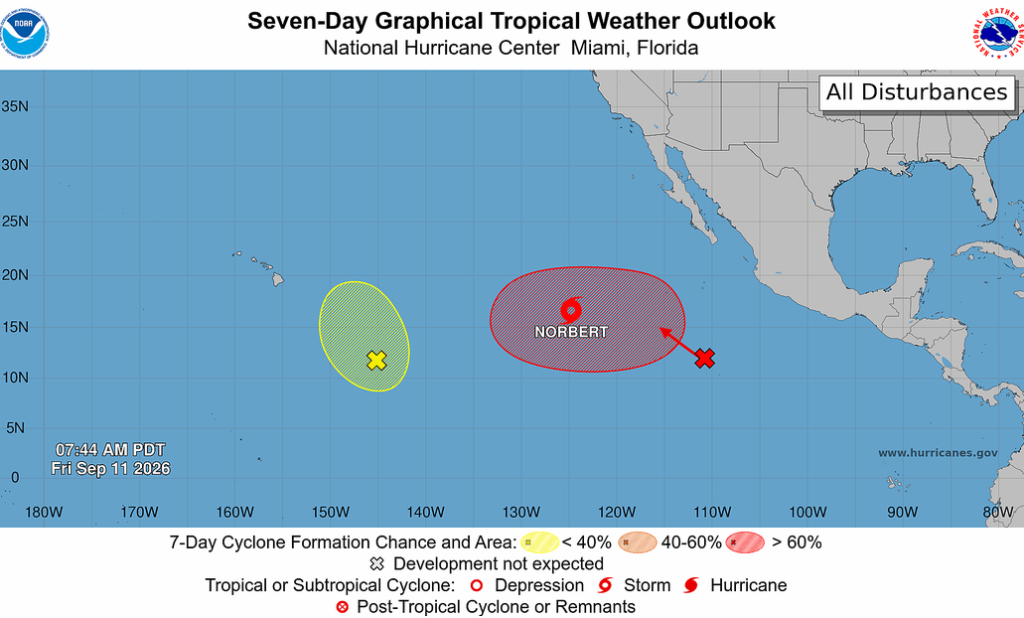
Only Tropical Storm Norbert is still active in the East Pacific, but another system will likely form before the weekend is over.
The jet stream is moving from northern California across the Rocky Mountains, then diving southeast into north central Texas. Moisture is over AZ/NM and in Mexico circling clockwise around the subtropical high pressure that’s centered in Sonora on the inland coast of the Gulf of California.

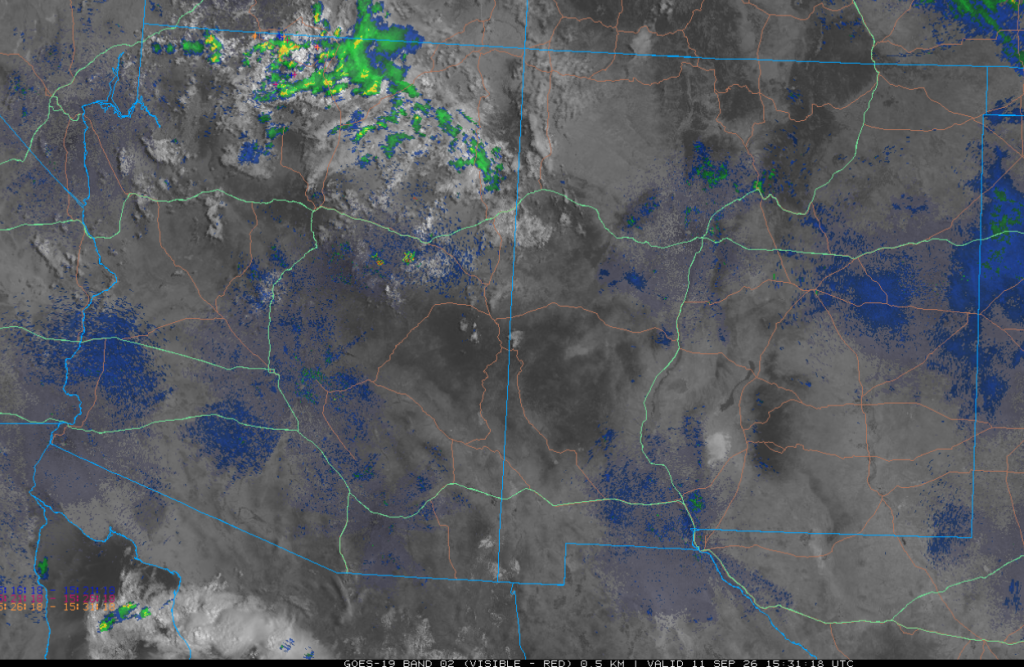
The 8:30 am visible satellite image overlaid with mosaic radar images shows showers in northern Arizona and southern Utah. To the south, showers are east and south of Puerto Peñasco.
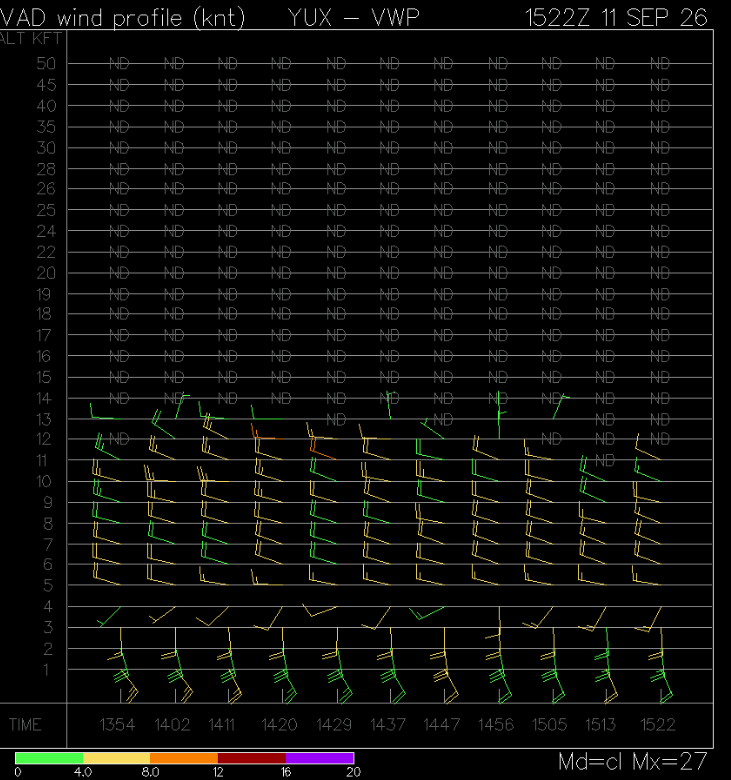
A gulf surge began yesterday morning in a layer within 1000 feet of the surface, strengthened overnight, and now has a vertical depth of 1km (3,000 feet) and 25 mph winds.
Southern Arizona has 60°F dewpoint temperatures this morning thanks to the gulf surge. Northeast Arizona and northern Mexico remain dry.

The HRRR-UA WRF 12Z initialization (left) and observed (right) sounding for Phoenix at 5 am are below. There’s not much difference between the initialization and observed soundings this morning, as both show the increase in precipitable water from the gulf surge, and although the subsidence layer near 480mb is better defined on the observed sounding, it can be implied to be there on the model initialization. The subsidence layer is not a cap, as it will be easily overcome if the convective temperature is reached.

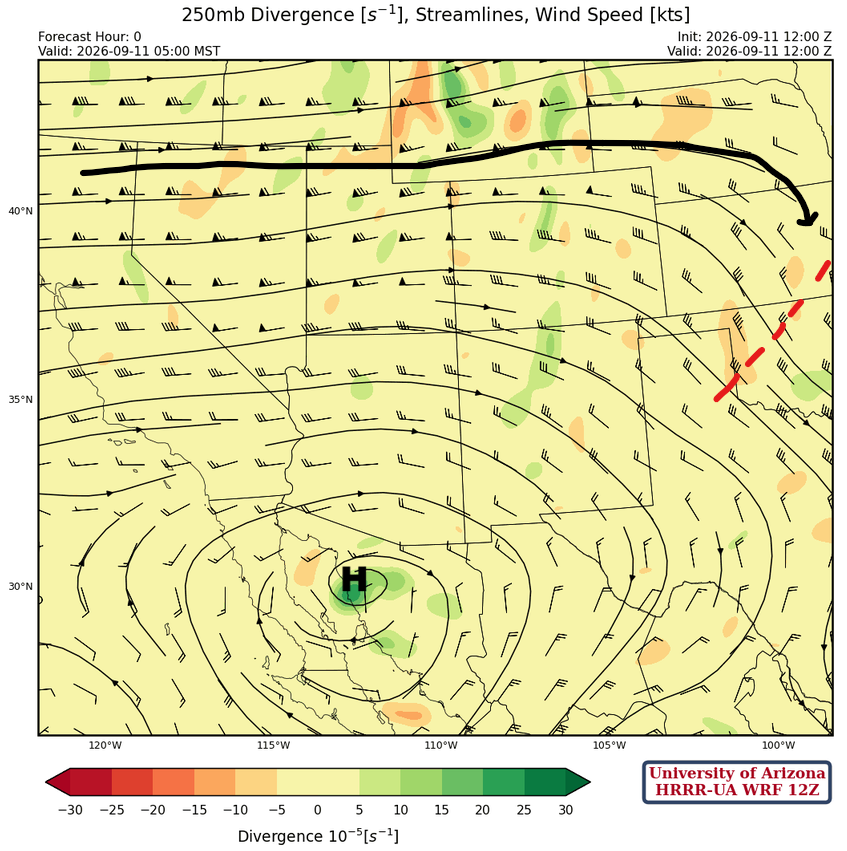
At 250mb, the jet stream moves west to east across southern Oregon and Utah and then bends southward into the Great Plains, being pulled southward by the short-wave trough in Oklahoma. The ridge center was over far northwest Mexico.
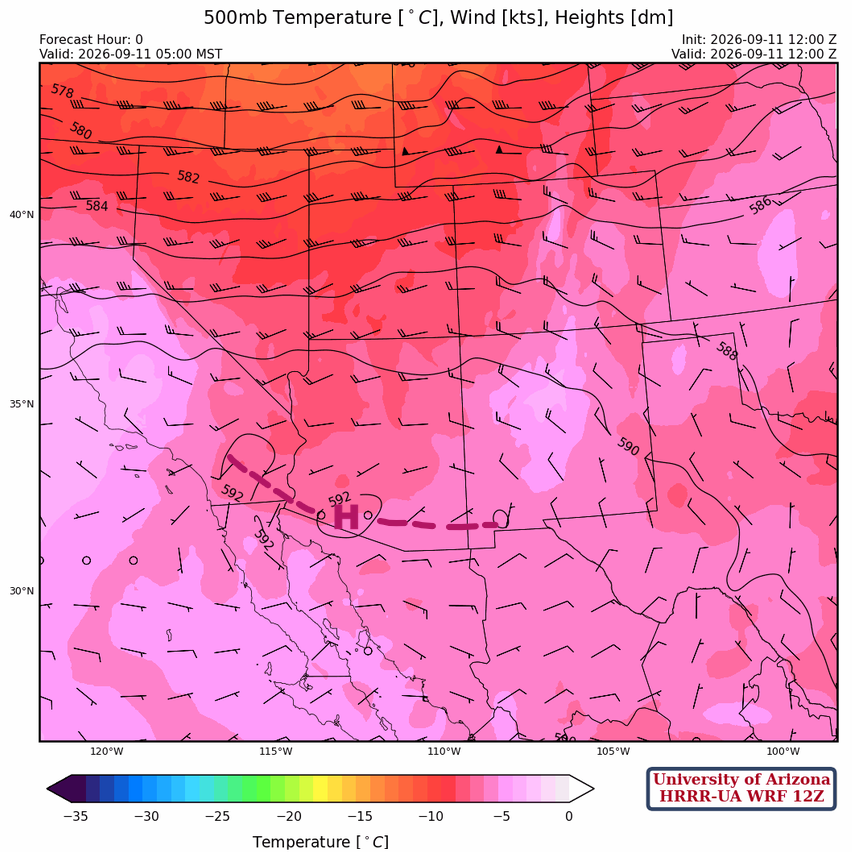
The high-pressure ridge is over southern Arizona at 500 mb. The jet and short-wave trough are just a little south of their 250 mb positions.
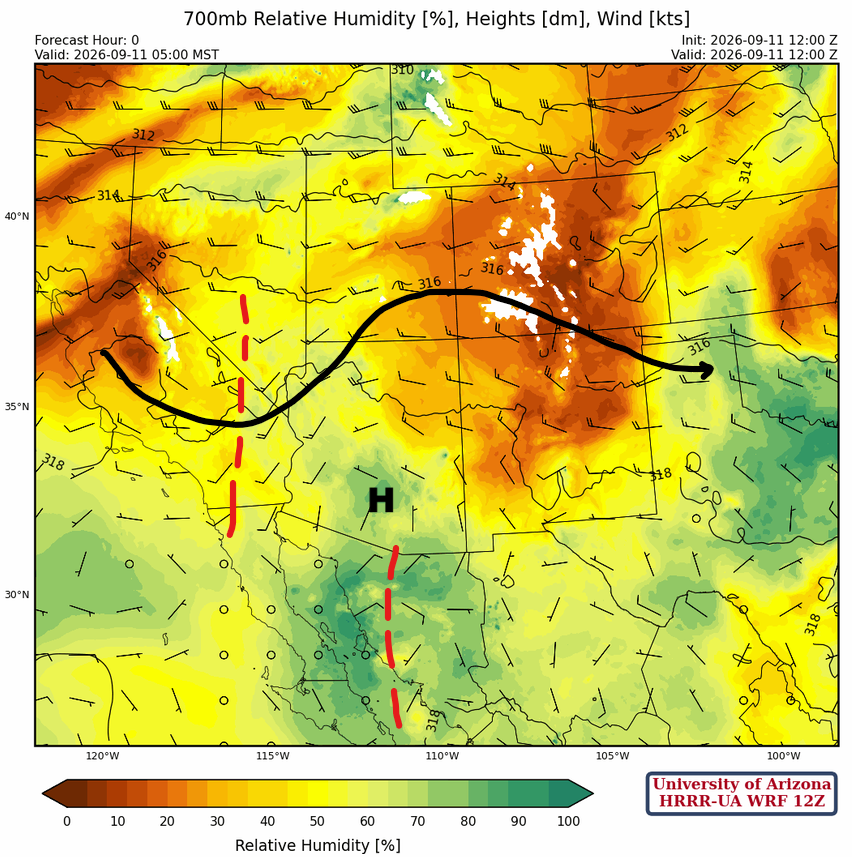
At 700mb, dry air across northern Arizona has shifted east, replaced by moist air from the gulf surge in northwest Arizona. The subtropical high pressure is over southern Arizona, but winds are light on the south side of the ridge axis. An easterly wave is south of Arizona and was probably associated with the MCS last night. Another short-wave trough across southeast California and southern Nevada is also helping pull the surge moisture northward.
Today
The forecast soundings for Phoenix at 11 pm (left) and Tucson at 5:30 pm (right) are shown below. For Tucson, the sounding shows storms moving off the mountains after 5 pm with 40 to 45 mph wind gusts. Thunderstorms that form in the Tucson area will propagate towards Phoenix along an outflow boundary late in the evening, initiating additional thunderstorms. Storms in the Phoenix area will move east as upper-level winds come from the west.

The 15Z HRRR-UA WRF simulated radar reflectivity and wind gusts are below. The storm’s intensity may be underestimated in the forecast because the higher dewpoint temperatures from the gulf surge may not be well represented yet. Along with wind gusts, there is potential for local heavy rain as thunderstorms move slowly northwest along the outflow boundary. Storms could move as far north as the Phoenix metro area and arrive after 10 pm, with blowing dust, and travel as far west as Buckeye and Wickenburg.
Tomorrow
On Saturday, most of southern Arizona will be dry, with only isolated mountain storms across eastern Arizona and New Mexico.
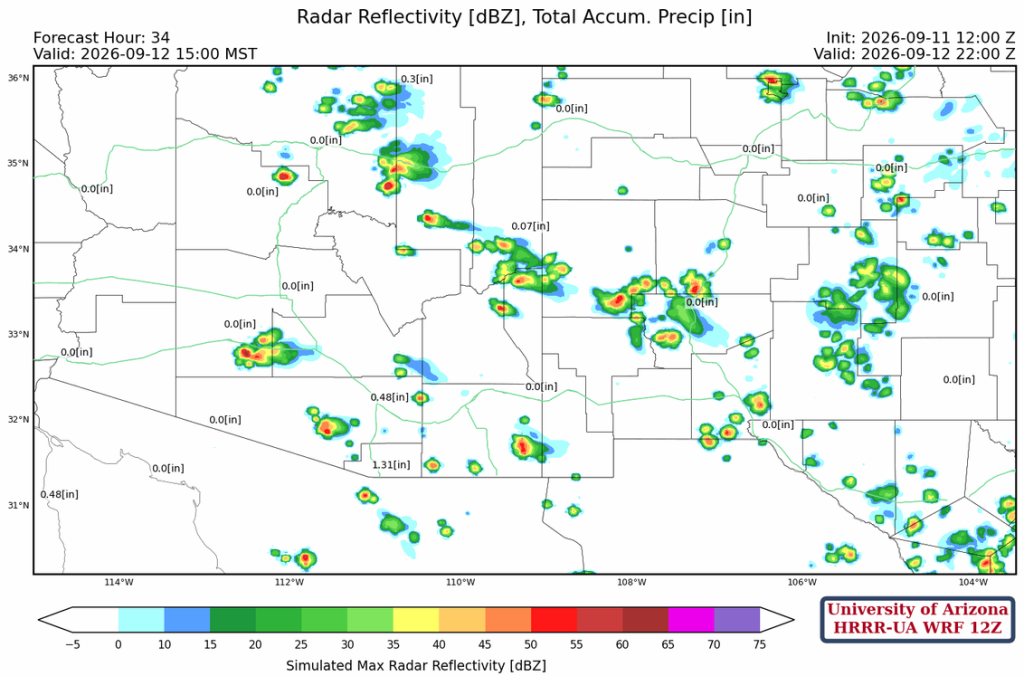
The 24- and 48-hour total precipitation forecasts from the 12Z HRRR-UA WRF show most precipitation will fall today, with only minor additional amounts on Saturday.
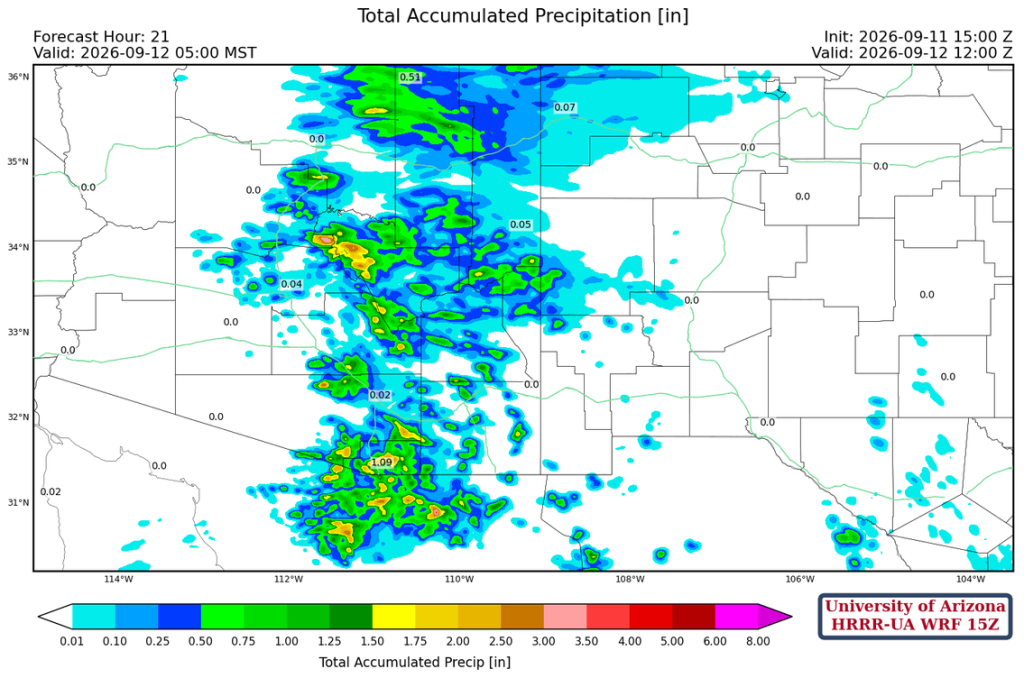
The 15Z HRRR-UA WRF total precipitation through to 5 am tomorrow is below and seems to have a better estimate of the precipitation northeast of Phoenix and in the Nogales area. Note that Phoenix metro on either the 12Z or 15Z forecast only gets spotty precipitation, less than a quarter inch.
Outlook
Thunderstorm coverage will increase across eastern Arizona and northern New Mexico on Sunday.
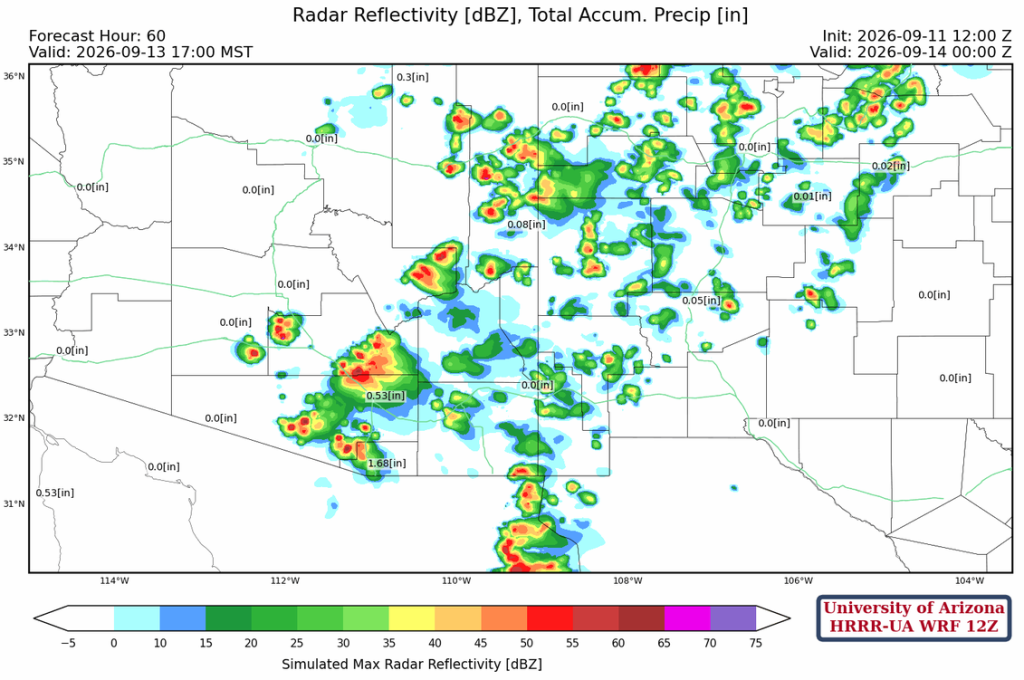
Next week, monsoon moisture will remain nearby, and any trough crossing Arizona could trigger more widespread storms. However, a low-grade monsoon scenario remains most likely next week, given this outlook.

Discussion written by Pat Holbrook and Patrick Bunn